-
Our Location Naroda, Ahmedabad, Gujarat.
-
Send Us Mail imprubtech@yahoo.com
-
Call Us +91 97125 64657
Our Location Naroda, Ahmedabad, Gujarat.
Send Us Mail imprubtech@yahoo.com
Call Us +91 97125 64657
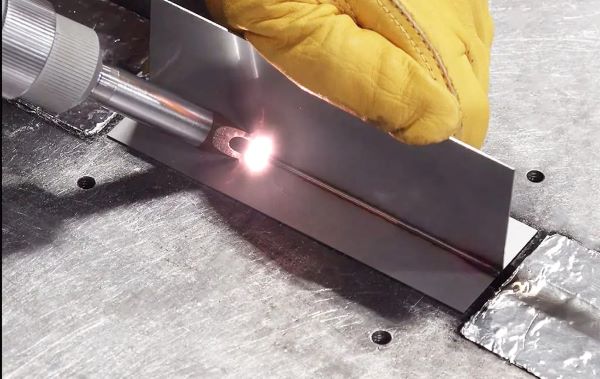 Laser welding is the process of transferring a laser beam's energy in the form of heat to fuse or join parts. This transferred heat melts the materials to form a molten weld pool that subsequently cools and fuses the targeted area together. Laser welding is a flexible process that can be performed with or without filler material and is used to create seams and joints that are narrow, wide, shallow, or deep in a variety of materials including metals, dissimilar and reflective materials, and non-metals.
Although lasers create a relatively small spot on the parts to be welded, weld pools that are significantly wider than the spot can be created by directing the beam in customizable patterns. For parts and materials that cannot handle excessive thermal input, lasers can be optimized to achieve rapid weld penetration and scanned along the joint to reach speeds as high as several meters per minute. Although laser welding is easily automated, the process is also easy to perform by hand using handheld laser welders as a faster, easier, and higher quality replacement for traditional handheld welding methods.
| Parameter | Arc Welding | Resistance Welding | Electron Beam Welding | Laser Welding |
|---|---|---|---|---|
| Welding Speed | Low | Low | Moderate | High |
| Heat Input | High | Moderate | Low | Low |
| Dissimilar Materials | No | No | Yes | Yes |
| Real-Time Weld Measurement | No | No | No | Yes |
| Maintenance | Moderate | Moderate | High | Low |
| Repeatability | Moderate | Moderate | High | High |
| Accessibility | Moderate | Low | Low | High |